The Quiet Reduction of Our Voice, Our Vote, and Our Power
Democracy is being weakened not by chaos, but by institutions whose decisions quietly strip power from the people they were built to protect. In case after case, the Supreme Court has reshaped the rules that govern voting rights and representation, narrowing protections, enabling extreme gerrymanders, and signaling to states that long-standing democratic guardrails can be ignored without consequence. These rulings do not announce themselves as threats. They arrive as technical shifts — changes in timing, doctrine, and interpretation — that functionally remove power from voters and deliver it into the hands of partisan actors. The erosion is deliberate, cumulative, and already altering the structure of our democracy. This page names that reality without hesitation: our voice, our vote, and our power are being reduced through institutional actions that remake the democratic landscape long before most people realize what has been lost — and who stripped it away from them.

Marc Elias, a longtime voting rights attorney, examines the Supreme Court’s recent ruling through the lens of institutional erosion and the shifting burden placed on voters. He describes how protections once considered stable have been weakened through precise legal revisions that reshape the landscape while appearing technical or procedural. Elias notes that each change, however small, alters the balance of democratic power and increases the pressure on voters to defend rights that were meant to be safeguarded by the system itself. His analysis underscores a broader pattern: when institutions step back from their own guardrails, the power of the people is quietly reduced. (Source: Democracy Docket member-only article by Marc Elias, April 2024; not publicly accessible.)
“When institutions step back from their duty, the weight of democracy falls on the voter alone.”

Design Notes
Why This Image
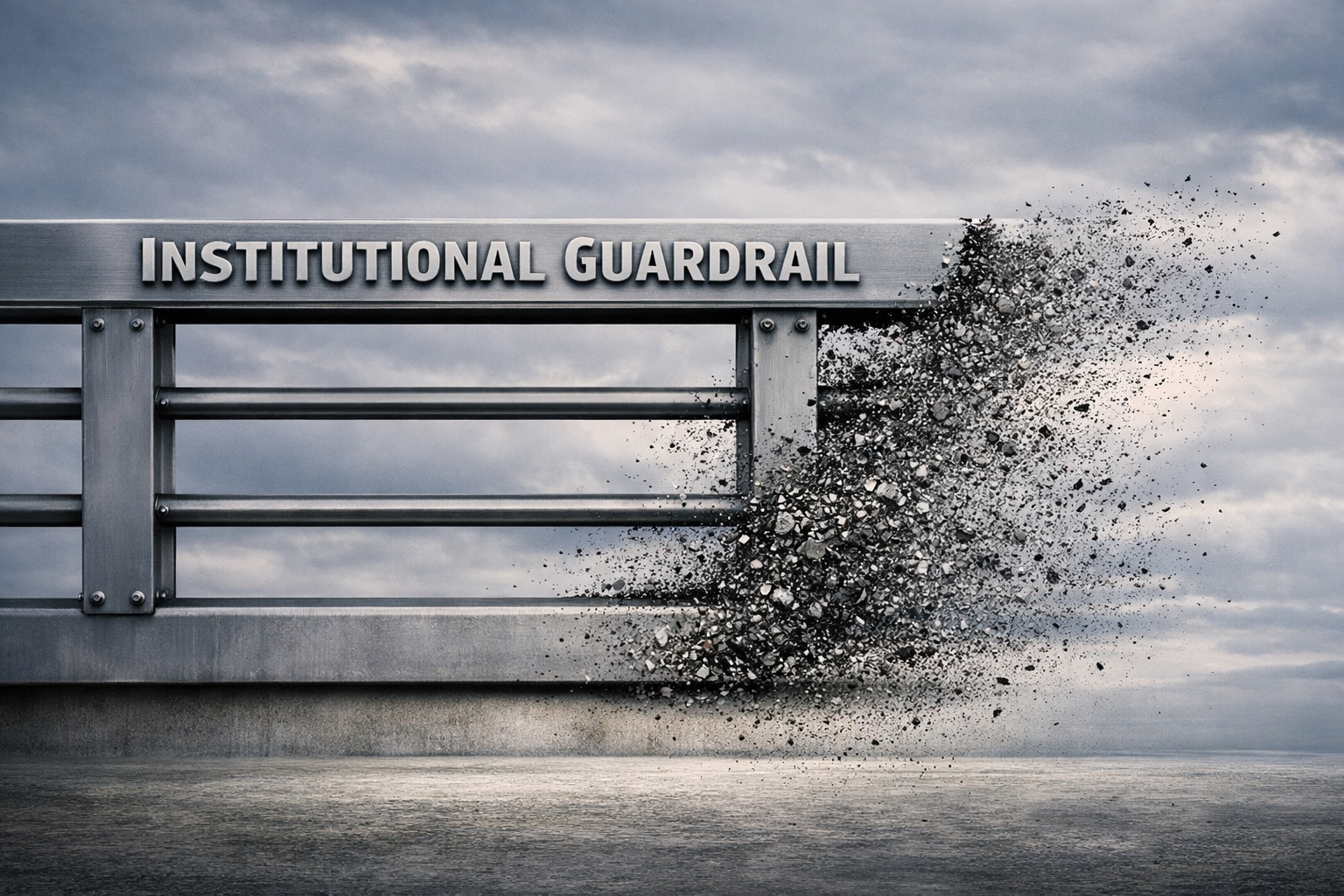
This image captures the moment when a democratic guardrail stops functioning as a boundary and begins dissolving into something unrecognizable. The guardrail is still present — still technically “there” — but its integrity is compromised. That tension between visibility and failure mirrors the quiet ways our collective power can be reduced without a single dramatic event.
Symbolic Function
The guardrail represents the institutional structures meant to protect our voice, our vote, and our shared civic power. Its fragmentation symbolizes the slow, often invisible processes that weaken those protections: procedural erosion, manipulated norms, and the steady normalization of anti-democratic behavior. The image functions as a visual metaphor for a system that looks intact from a distance but is failing at the structural level.
Civic Meaning
This is not about spectacle; it’s about the subtle shifts that change the lived experience of democracy long before the public recognizes the danger. The erosion of the guardrail reflects the erosion of representation, accountability, and equal access to power. It signals that the reduction of our civic voice rarely begins with a crisis — it begins with a quiet loss of structural integrity.
Why It Opens the Page
The HERO image sets the emotional and civic frame for the entire piece. It tells the reader: This page is about what we lose before we realize we’re losing it. By opening with a guardrail in mid-collapse, the page invites the reader to look closely at the early signs of democratic reduction — the ones that are easy to overlook until the damage is already underway.
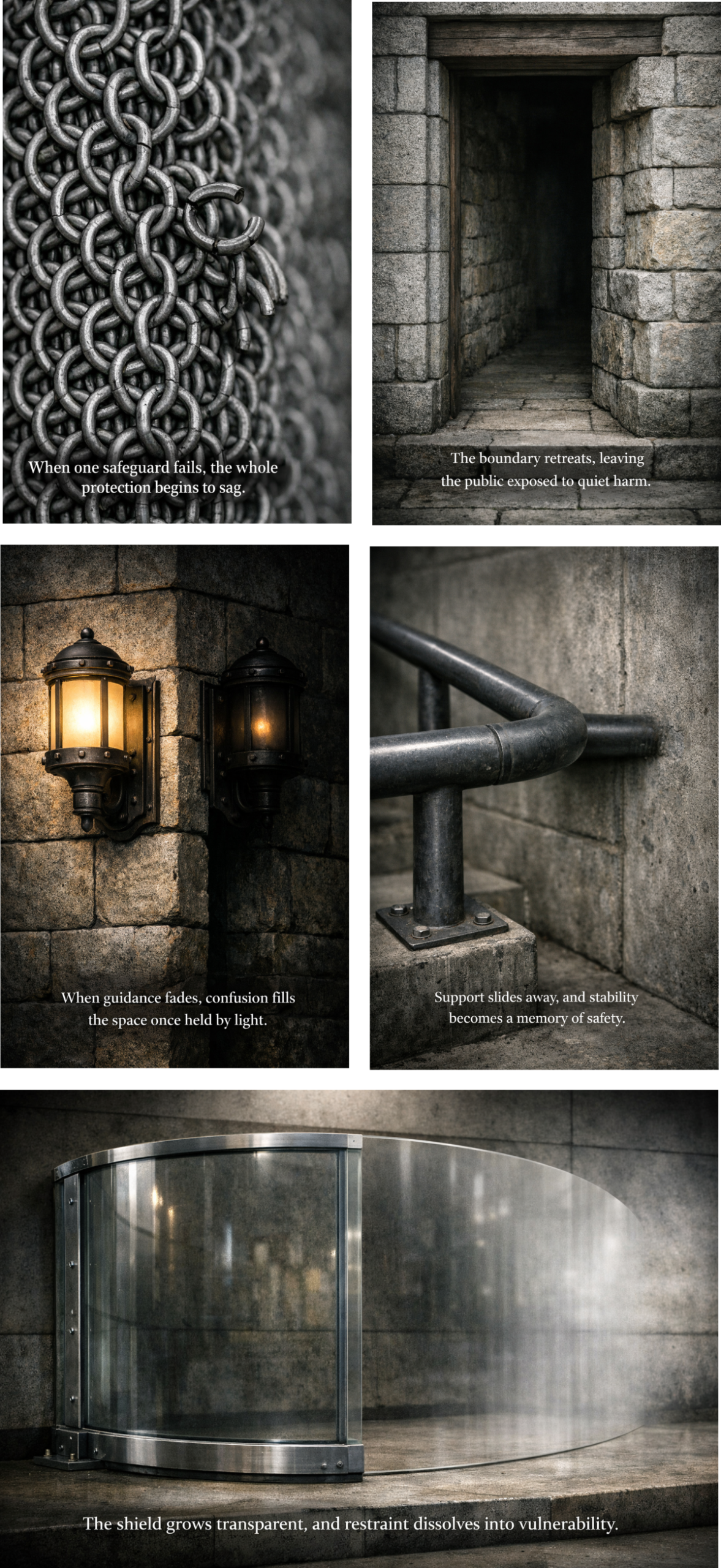
For readers tracking how institutional failures are accelerating the reduction of our collective power, the distilled source summary is included below.
What This Resource Reveals
Marc Elias’ analysis lays bare a structural truth: the institutions meant to protect democratic participation are not merely weakening — they are being repurposed in ways that actively diminish the power of voters, especially minority voters. His account of the Supreme Court’s recent actions shows a Court that is no longer functioning as a neutral arbiter, but as an accelerator of anti-democratic outcomes. The pattern is not episodic. It is systemic.
The Structural Harm Identified
The article documents a series of decisions in which the Court has abandoned its own stated principles — timing rules, precedent, procedural fairness — whenever those principles would protect voting rights. In their place, the Court has adopted a posture that enables gerrymandering, weakens the Voting Rights Act, and signals to state actors that they can violate constitutional norms without consequence. This is not drift. It is a deliberate shift of institutional power, stripped away from voters and delivered into the hands of partisan actors.
The Asymmetry of the Fight
Elias names a dynamic that is essential to understanding the moment: the fight for democracy is structurally asymmetric. Those working to protect voting rights must win repeatedly, across multiple fronts, under compressed timelines. Those seeking to undermine democratic participation need only win selectively — a single ruling, a single map, a single procedural manipulation can shift power for years. This asymmetry is not theoretical. It is already shaping outcomes in states like Louisiana and Florida, where unconstitutional maps are being greenlit in real time.
Why This Resource Matters Now
The article captures the emotional and civic reality of this moment: the sense that institutional guardrails are not just failing but being dismantled from within. It underscores the urgency of collective vigilance and the necessity of refusing despair, even as the structural terrain becomes more hostile. The warning is clear: democratic erosion is happening through quiet, procedural mechanisms that most people never see — unless someone names them. This resource names them.
They strip the power. We live with the consequences.
The guardrail didn’t fall — it was removed.
The shift is deliberate. The loss is ours.
Institutional decisions. Public consequences.
The erosion is intentional. The harm is real.