Paperclips: The Quiet Strength That Holds Us Together
There are moments in our history when the country did not need louder voices — it needed steadier hands. Times when the most powerful act an ordinary person could take was simply to show that they were still here, still paying attention, still willing to stand with one another when the ground felt uncertain.
The story we’re stepping into now is one of those moments.
It’s a reminder that civic strength has never belonged only to institutions or leaders. It has always lived in the quiet decisions people make to stay connected, to stay informed, and to refuse to drift into silence. The paperclip began as a small symbol of that choice — a way for people to signal to one another that they were part of something larger than themselves, even when the world around them felt unsteady.
We return to that history now not out of nostalgia, but because the lesson still holds. When the future feels unclear, the simplest symbols can become anchors. And when people choose to carry them together, they become a quiet declaration: we are still here, and we still believe in one another — and in defending the democratic ideals that hold this country together.

This page draws from Robert Arnold’s January 21, 2026 video reflection on the first year of the second Trump administration, a piece that examines the architecture of authoritarian drift and the emotional toll of sustained chaos. Arnold argues that the acceleration, confusion, and rule shifting of the past year are not signs of strength but symptoms of a brittle system dependent on fear and overwhelm. He situates this moment within historical patterns, noting that systems built on domination eventually collapse under their own instability. The piece centers ordinary people as the counterforce to resignation, highlighting the quiet forms of solidarity that keep moral memory alive. Arnold invokes the story of Swedish teachers who wore paperclips during World War II as a small, visible act of resistance — a reminder that dignity, presence, and human connection are what carry communities through dark seasons.
“Evil is loud, but it is not strong.”


Design Notes
Why This Image
This image centers on a single paperclip held gently but firmly between the fingers of an older woman — a quiet, human gesture that carries the weight of memory. The steadiness of her hand, the softness of the light, and the simplicity of the object create an immediate emotional anchor. It signals that this page begins not with spectacle, but with a small act of moral clarity.
Symbolic Function
The paperclip stands in for the ordinary tools people use to hold things together — documents, stories, communities, and truths. In her hand, it becomes a symbol of personal responsibility: the choice to keep what matters intact. The image distills the motif into its purest form: one person, one object, one act of steadiness.
Civic Meaning
This is not about spectacle; it’s about the subtle shifts that change the lived experience of democracy long before the public recognizes the danger. The erosion of the guardrail reflects the erosion of representation, accountability, and equal access to power. It signals that the reduction of our civic voice rarely begins with a crisis — it begins with a quiet loss of structural integrity.
Why It Opens the Page
The page begins here because the entire argument rests on this premise: that the strength of a democracy is found in the hands of its people. This single paperclip, held steady, is the thesis in visual form. It invites the reader into a story about memory, responsibility, and the quiet power of ordinary citizens choosing to hold things together.
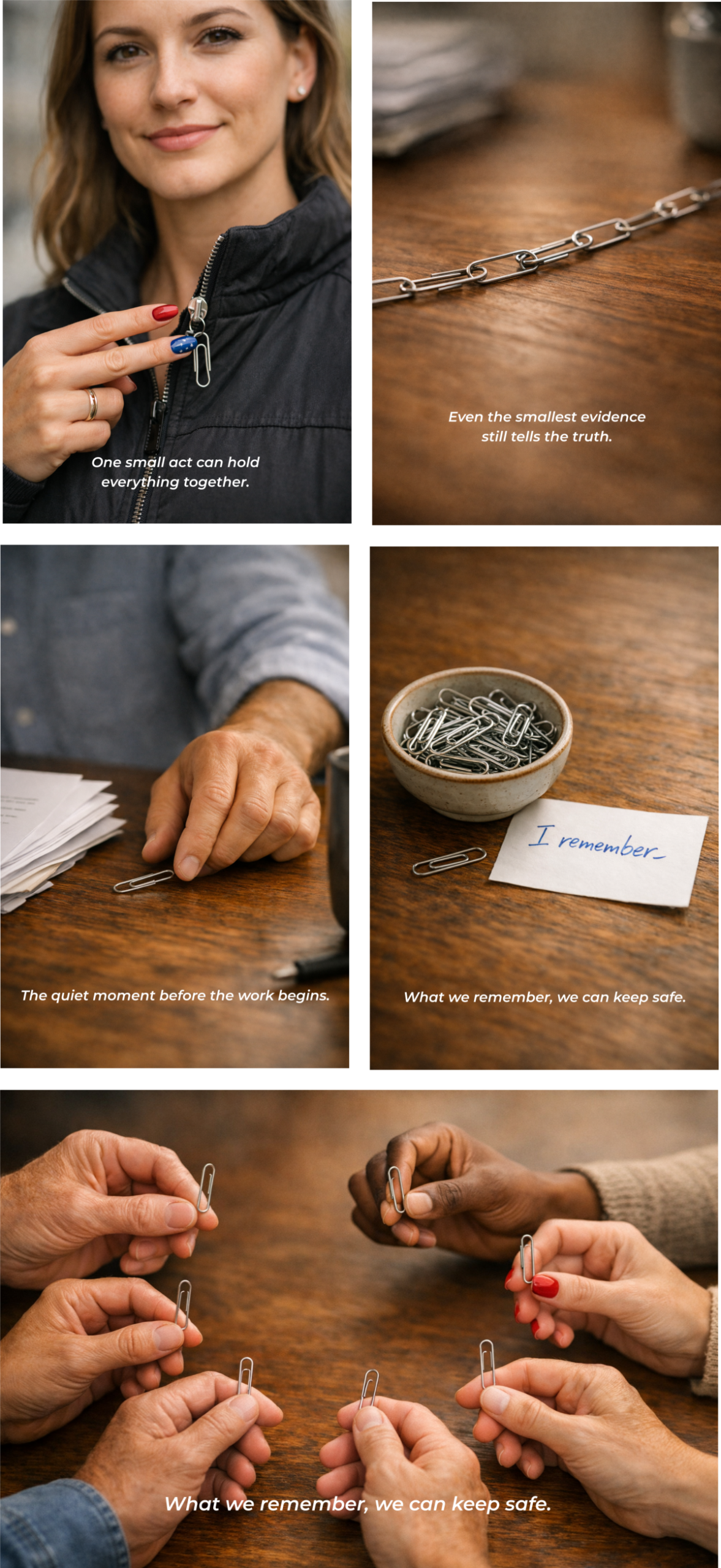
When we choose to remember, we choose to hold the line together.
Why This Post Matters
The story of the paperclip is a reminder that resistance often begins with something small — a gesture so ordinary it could be overlooked, yet powerful enough to signal that people still recognize the difference between what is right and what is merely allowed. This post returns to that quiet act of defiance to show how moral memory is carried not only by institutions, but by individuals who refuse to forget what solidarity looks like. The paperclip becomes a symbol of that choice: a simple object that holds things together when the world feels like it’s coming apart.
In today’s civic landscape, the pressures are different, but the stakes are familiar. Disinformation, manufactured narratives, and the erosion of shared truth create a climate where people can feel isolated in their convictions. The paperclip motif counters that illusion of isolation. It reminds us that millions of ordinary citizens still believe in the work of holding the line — not through spectacle, but through steady, consistent acts of care, attention, and accountability. This post names that work and honors the people who do it quietly.
The paperclip also represents the connective tissue of democracy: the links between neighbors, communities, and generations who choose to remember what has been fought for and what must not be lost. It is a symbol of continuity — a way of saying that the responsibility to safeguard democratic norms does not disappear simply because the news cycle moves on. Memory is a civic act, and this page calls readers back to that responsibility.
This post matters because it reframes the paperclip not as nostalgia, but as a living civic gesture. It invites readers to see themselves as part of a larger collective — one that understands the power of small, steady actions in a time when the loudest voices often drown out the most important truths. The paperclip is a reminder that democracy is held together by the hands of its people, one quiet act at a time.
When We Remember Who We Are, We Protect What We Share.