The Flame We Keep
Introducing The Protector Frame
There are moments in a nation’s life when the work of citizenship shifts.
When the question is no longer, What do we oppose?
but rather,
What do we protect?
We are living in such a moment now.
And the truth is simple, steady, and unshakable:
We are not protestors.
We are protectors.
We stand guard over what must endure.

II. The Line We Hold
For too long, the language of civic action has been framed as disruption — as if the people who show up, speak out, and refuse to look away are somehow destabilizing forces.
But the destabilization did not come from us.
It came from:
- those who erode norms
- those who undermine institutions
- those who distort truth
- those who treat democracy as disposable
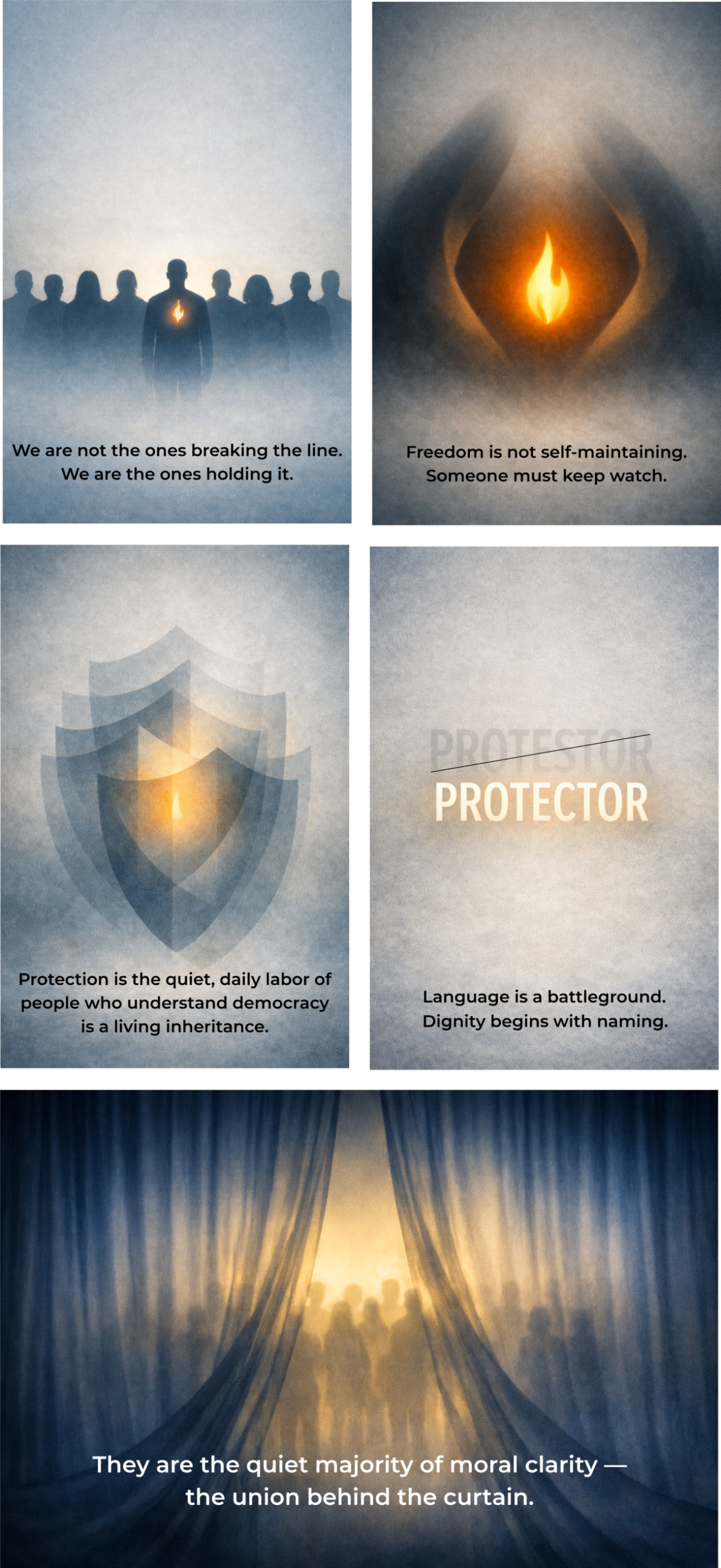
We are not the ones breaking the line.
We are the ones holding it.
The work of protection is not loud.
It is not chaotic.
It is not performative.
It is steady.
It is human.
It is necessary.
III. The Flame We Keep
Every democracy has a flame — a symbolic inheritance passed from one generation to the next.
It is not a bonfire.
It is not a blaze.
It is not a spectacle.
It is a steady flame, kept alive by ordinary people who understand that freedom is not self‑maintaining.
This flame survives because:
- someone keeps watch
- someone stands guard
- someone protects the fragile, essential light
- someone refuses to let the wind take it
This is the work of protectors.
Not protestors.
Not disruptors.
Not agitators.
Protectors.
IV. The Work of Protecting
Protection is not passive.
It is:
- showing up
- naming truth
- refusing distortion
- defending the vulnerable
- safeguarding the vote
- holding institutions accountable
- keeping the flame visible when others try to dim it
Protection is the quiet, daily labor of people who understand that democracy is not a machine — it is a living inheritance.
And inheritances must be cared for, not assumed.
The frame of The Flame We Keep centers on a single truth: democratic resilience is not an accident — it is a choice made daily by ordinary people who refuse to let the light go out.
This page reveals the quiet, stubborn, unglamorous work that keeps a democracy alive when institutions wobble, leaders falter, and the national narrative fractures. It reframes civic endurance not as a grand gesture but as a sustained, collective act of will.
The frame argues three core ideas:
1. The flame is not symbolic — it is operational.
Democracy survives because people keep showing up: voting, organizing, correcting misinformation, protecting rights, and refusing to normalize corruption or cruelty. The flame is the sum of these actions.
2. The keepers of the flame are not the powerful — they are the public.
The page shifts focus away from political elites and toward the millions of citizens who maintain the civic infrastructure through vigilance, compassion, and persistence.
3. The flame endures because it is shared.
No single person carries the burden. The strength of the flame comes from its distribution — across communities, generations, identities, and geographies. It is a collective inheritance and a collective responsibility.
The frame positions The Flame We Keep as a reminder and a rallying point:
Democracy is not self-sustaining. It survives because people protect it.
And in this moment of noise, fatigue, and engineered division, the page asserts that the flame is still burning — because we are still here to keep it.
“Every democracy has a flame — a symbolic inheritance passed from one generation to the next.”

Design Notes
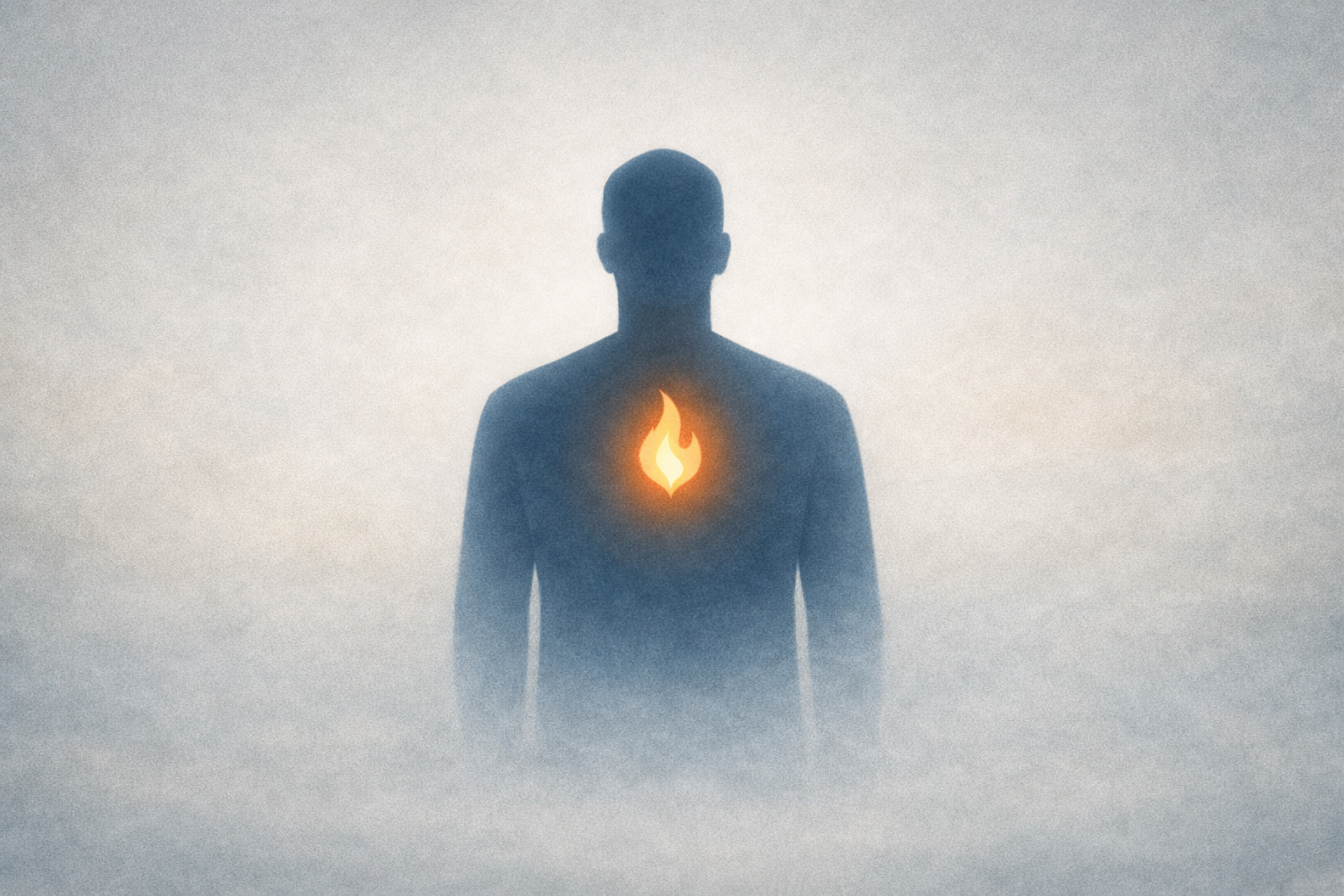
Why This Image
The image centers the idea that democracy is sustained not by spectacle but by the internal fire carried by ordinary people. The solitary figure, turned away from the viewer, universalizes the subject — this could be anyone, anywhere — which reinforces the theme that the flame is collective, not individual. The glowing ember at the chest is the visual anchor: simple, unmistakable, and emotionally resonant.
Symbolic Function
The flame represents civic will — the stubborn, renewable energy that keeps democratic values alive even in dark or uncertain conditions. The mist surrounding the figure symbolizes the moment we are living through: unclear, unstable, and often disorienting. The flame cutting through that haze signals that clarity and direction come from within the public, not from institutions or leaders.
Civic Meaning
This image reframes civic participation as an act of inner endurance. It suggests that the health of the nation depends on millions of quiet, unseen acts of commitment — people choosing truth over propaganda, compassion over cruelty, and persistence over fatigue. The flame is not dramatic; it is steady. That steadiness is the civic power the page is naming and honoring.
Why It Opens the Page
The HERO sets the emotional tone for the entire piece. Before the reader encounters any argument or evidence, they are grounded in the central truth: the flame is alive because we keep it alive. The image invites the reader to see themselves as a keeper of that flame — not as a spectator to democracy, but as its sustaining force. It is the perfect visual doorway into a page about endurance, responsibility, and shared civic fire.
Why This Post Matters
Words shape perception.
Perception shapes narrative.
Narrative shapes power.
For decades, the word “protestor” has been used to diminish, dismiss, and distort the work of civic engagement.
But the indigenous Hawaiian activists understood something profound:
Language is a battleground.
And dignity begins with naming.
They refused the word “protestor.”
They claimed the word “protector.”
We follow in that lineage.
We correct the record.
We reclaim the frame.
We restore the truth.
We are protectors of American democracy.
VI. The Union Behind the Curtain
The real strength of a nation is not found in its institutions alone.
It is found in the people who refuse to let those institutions fail.
The protectors are:
- the ones who vote
- the ones who organize
- the ones who teach
- the ones who speak
- the ones who show up
- the ones who refuse to surrender the narrative
- the ones who keep the flame alive
They are the quiet majority of moral clarity — the union behind the curtain.
We are not protesters. We are protectors.